Hands Giving Out in Aerial Yoga? It's Usually Grip Endurance, Not Strength
Quick Answer: Aerial grip failure is almost always an endurance problem rather than a maximum-strength problem. Your hands can hold your bodyweight; they can’t hold it for 40 seconds repeatedly. The fix is isometric hang work - short, frequent holds two to three times a week - plus technique changes that shift load off the fingers. Most people see a meaningful change in four to six weeks.
You get into the pose, everything feels fine, and around second twenty your forearms start screaming and your hands begin to slide. That’s a specific, fixable failure - and it’s not a sign you’re not strong enough for aerial.

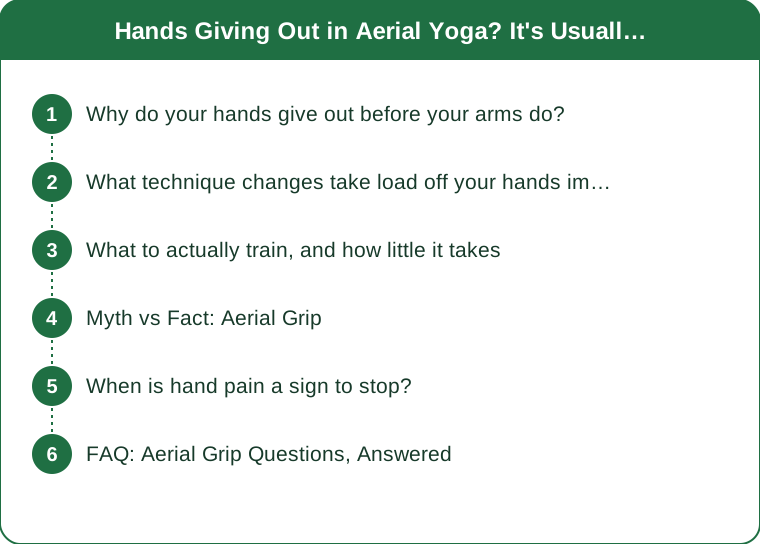
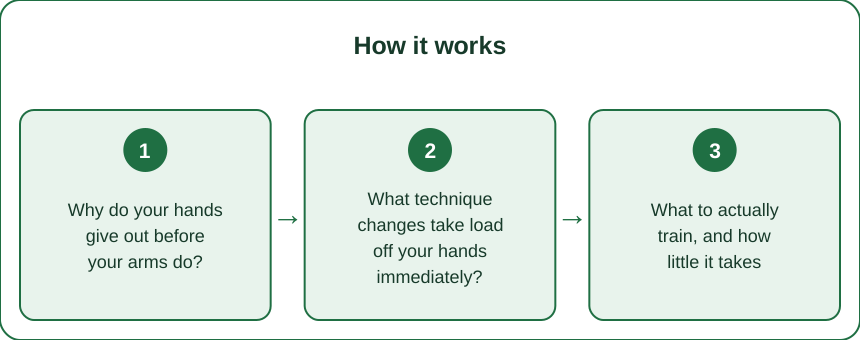
Why do your hands give out before your arms do?
Because grip endurance and grip strength are different qualities, and aerial demands the one nobody trains.
Maximum grip strength is what you can hold for a second or two. Most adults have plenty for aerial work.
Grip endurance is holding a submaximal load for 20-60 seconds, repeatedly, with short rests. That’s what a class actually asks for, and it’s the quality that fails first.
The forearm burn is the flexor muscles working under sustained tension with restricted blood flow - a sustained isometric hold squeezes the vessels in your own forearm, so the muscle is working while partly cut off from its own supply. That’s why the burn arrives on a timer rather than at a specific difficulty.
Three things make it arrive sooner:
- Over-gripping - squeezing at 100% when 60% would hold
- Fabric tension - a loose hammock demands more grip than a taut one for the same shape
- Skipping the rest - the flexors need 60-90 seconds to clear between hard holds, and most class formats don’t give it
What technique changes take load off your hands immediately?
Several, and these work in your next class without any training block.
Wrap instead of grip wherever the shape allows. A fabric wrap around the wrist or forearm carries load through skin and bone contact rather than through finger flexors. Ask your instructor which shapes in your syllabus have a legal wrap variant - most have at least one.
Hook, don’t clamp. In a hanging grip, the fingers act like hooks and the thumb often adds very little. Consciously relaxing your thumb and reducing squeeze pressure by about a third usually costs no security and buys noticeable time.
Get your body weight closer to the fabric. The further your hips hang from the point of contact, the more your grip has to fight rotation. Small posture corrections change the demand more than strength does.
Stop chalking over sweat. Chalk on damp hands makes a paste that’s slipperier than either. Dry first, then chalk lightly.
Use the legs. In hammock work especially, an engaged leg or a foot hooked into the fabric can offload a large fraction of the grip demand - and beginners consistently forget it’s available.
What to actually train, and how little it takes
Ten to fifteen minutes, two or three times a week, on non-class days. More than that and your hands won’t recover between sessions.
The core exercise: dead hangs. From a bar with a relaxed shoulder position, hang for a set time rather than to failure.
- Week 1-2: 4 sets of 15 seconds, 90 seconds rest
- Week 3-4: 4 sets of 25 seconds
- Week 5-6: 4 sets of 35-40 seconds
- Feet lightly on a box to reduce load if a full hang is too much - this is the correct scaling, not shortening the hold
Add one supporting movement:
- Farmer’s carries, 2 x 40 seconds per hand with a moderate weight, for endurance under a different grip pattern
- Wrist extensor work - light reverse curls, 2 x 15 - because forearm pain in aerial is often the extensors being outmatched by dominant flexors
What to skip: grip trainers you squeeze while watching TV. They train the wrong quality and add fatigue without carryover. Time under tension while hanging is the specific stimulus, and there isn’t a shortcut around it.

Myth vs Fact: Aerial Grip
Myth: Your hands hurt because you’re not strong enough for aerial. Fact: Grip endurance is the limiter for nearly everyone in the first year, including strong people. It’s a training-age issue, not a strength ceiling.
Myth: Calluses mean you’re doing it right. Fact: Some thickening is normal. Deep, raised, catching calluses are a sign of excessive shear and are the ones that tear. File them down flat.
Myth: Gloves solve it. Fact: Gloves reduce skin damage but often increase grip demand, because you lose fabric feel and compensate by squeezing harder. Useful for skin, unhelpful for endurance.
Myth: Wrist pain and forearm burn are the same problem. Fact: Burn is muscular and expected. Sharp wrist pain, numbness, or tingling into the fingers is not, and warrants stopping and getting it looked at.
Myth: You should train grip on class days too, since it’s only ten minutes. Fact: Forearm flexors are small and recover slowly under repeated isometric load. Stacking grip work onto class days is the most common cause of the nagging elbow-side pain that appears in month two.
When is hand pain a sign to stop?
Most of it isn’t - but three signals are worth taking seriously.
Numbness or tingling into the fingers, especially if it persists after class. Nerve symptoms are different from muscular burn and shouldn’t be trained through.
Sharp pain on the inside or outside of the elbow that appears during gripping and lingers the next day. Common in months two to four when volume ramps faster than tissue adapts. The fix is usually a two-week volume cut, not rest and then the same volume.
Skin that tears rather than blisters. Torn skin needs to heal properly before it goes back on fabric, and covering it to get through class is how a small tear becomes a three-week break.
Routine burn, temporary weakness, and hands that feel clumsy for an hour after class are all normal in the first months.
If pain persists beyond a couple of weeks of reduced load, get it assessed by a physio who works with climbers or gymnasts - they see this pattern constantly. This is general information, not medical advice.
FAQ: Aerial Grip Questions, Answered
How long until my grip stops being the limiting factor?
With consistent hang work, most people report a clear change in four to six weeks and stop thinking about grip by around three months. Class attendance alone gets you there too, just slower.
Should I train grip before or after aerial class?
After, if the same day, and lightly. Before class means arriving with pre-fatigued flexors, which changes your technique in exactly the wrong direction.
Does hand size matter?
Somewhat for bar work, much less for fabric, because fabric conforms to your hand. Smaller hands are not a disadvantage in aerial the way they can be in some climbing.
Is chalk or grip spray better?
Chalk for sweaty hands, nothing for dry hands. Grip sprays vary hugely and some leave residue that studios don’t allow on their fabric - ask before bringing one.
TL;DR:
- Grip failure in aerial is endurance, not maximum strength
- Dead hangs for time, 2-3x weekly, 15 seconds building to 40 over six weeks
- Relax the thumb, hook rather than clamp, and use legal wraps to offload the fingers
- Add wrist extensor work - forearm pain is often extensors, not flexors
- Numbness, sharp elbow pain, or torn skin means stop; burn means keep going
Your hands aren’t the reason you’re not progressing. They’re just the part nobody trained, and they respond faster than almost anything else you could work on.
See It in Motion
Seen here: Super High Waist Embossed Yoga Leggings with Inner Pocket — shop it on bubblelime.com
Keep Reading
This article is for general informational and styling purposes only. Fit, sizing, and product availability may vary.