Your Aerial Grip Limit Is Usually Skin, Not Strength
Quick Answer: If your hands burn and release before your lats or biceps fatigue, the limiter is skin tolerance and forearm endurance rather than raw strength. Skin conditions on a slower timeline than muscle - roughly 6 to 12 weeks of consistent, moderate exposure - and it regresses fast after two weeks off. Shorter, more frequent hangs beat long ones, and grip tape or gloves delay conditioning rather than building it.
Your pull-ups are fine. Your back is not what quits. Somewhere around the fourth climb your palms go hot and slick, the fabric feels like it is made of sandpaper, and your hands simply open. That is not a strength ceiling, and training it like one is why it has not improved.

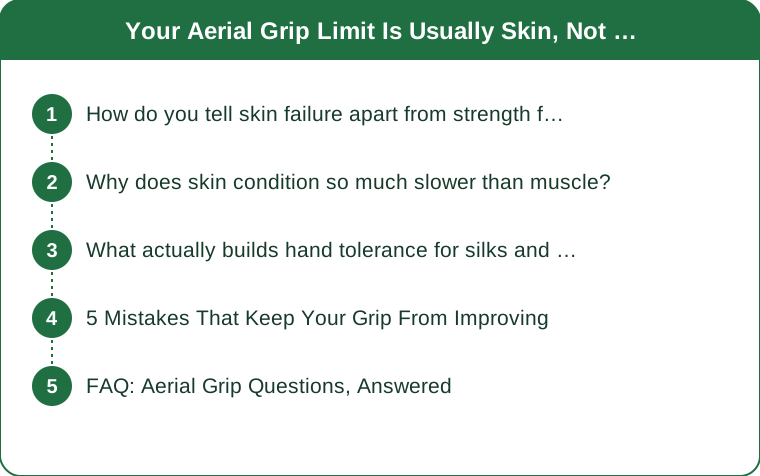
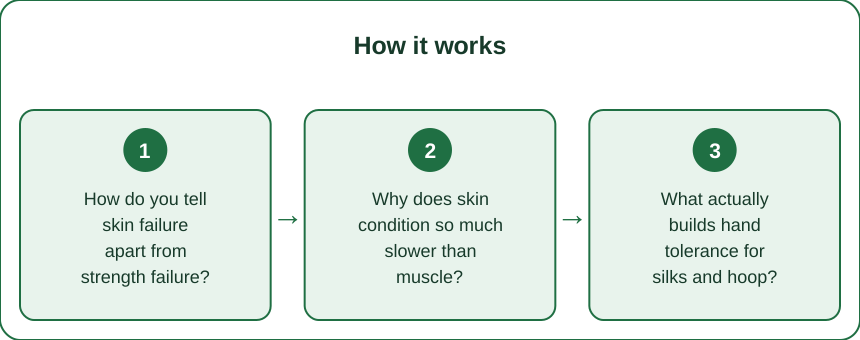
How do you tell skin failure apart from strength failure?
Skin failure is hot, sharp, and local to the palm; strength failure is dull, spreading, and shows up in the forearm or upper back. They feel almost nothing alike once you know to look.
A more reliable test: rest 90 seconds and try again. Muscular fatigue needs considerably longer than that to clear, so if the second attempt is nearly as good as the first, the first one ended for skin reasons.
This distinction matters because the two problems are trained in opposite directions. Muscle wants load and rest. Skin wants frequency and moderation.
Why does skin condition so much slower than muscle?
The layer that matters thickens through repeated moderate friction, and that process runs on a timescale of weeks. Push too hard and you tear instead of thicken, which resets you further back than doing nothing.
The common mistake is treating a good day as permission to double the volume. Four extra climbs when your hands felt strong is how you arrive at a torn palm that costs three weeks.
Aim for the point where your hands feel warm and worked but not raw, and then stop. That is the productive zone, and it is much earlier than most people expect.

What actually builds hand tolerance for silks and hoop?
Short, frequent exposure with full recovery between sessions. Three sessions a week with six to eight moderate climbs beats one session with twenty.
Between sessions, keep the skin supple rather than dry. Fully dry, hardened calluses catch on fabric and tear at the edge; slightly filed and lightly moisturized skin is more durable. File down any ridge you can feel with a thumbnail.
Humidity matters more than people expect. Late-August humidity means sweatier palms and more slip, which drives people to grip harder and burn skin faster - a reason your hands may be failing sooner than they did in spring.
5 Mistakes That Keep Your Grip From Improving
1. Using tape or gloves for every session. They are useful for a performance or a specific injury, but full-time use means skin never receives the stimulus that would condition it. Save them for when you need output rather than adaptation.
2. Training grip to failure. Grip trained to complete failure produces torn skin more often than adaptation. Stop two climbs before the end.
3. Over-chalking. Chalk beyond a light coat increases friction to the point where the skin shears rather than grips. A thin layer is the goal.
4. Ignoring technique that dumps load into the hands. A climb driven mostly by arms loads the palms enormously. Improving footlock efficiency reduces hand demand more than any conditioning program.
5. Taking two weeks off and resuming at the same volume. Skin de-conditions noticeably in about two weeks. Come back at roughly 60 percent of your previous volume for the first session or you will tear on day one.
FAQ: Aerial Grip Questions, Answered
Should I pop a blister or leave it?
Leave it intact if you can - the roof is the best dressing available. If it tears, keep it clean, cover it for training, and let it breathe otherwise. Anything with spreading redness or heat needs a professional, not a forum. This is general information, not medical advice.
Do grip strengtheners help with aerial?
Modestly. They build forearm endurance, which helps if that is genuinely your limiter, but they do nothing for skin tolerance and nothing for the technique issue that is often the real cause.
Why are my hands worse on some days for no obvious reason?
Hydration, humidity, time of day, and where you are in your cycle all measurably affect skin and grip. A bad hand day is usually not a training regression - check the room temperature before you rewrite your program.
TL;DR:
- Hot, sharp palm pain is skin; dull forearm or back fatigue is strength.
- Skin conditions over 6 to 12 weeks with frequent moderate exposure, not hard sessions.
- File ridges and keep skin supple - dry hard calluses tear at the edges.
- Come back from a two-week break at about 60 percent volume.
Grip is the most common thing that stalls aerial progress and the least commonly trained correctly. Treat your hands as tissue with their own adaptation timeline, and the ceiling that felt fixed usually moves within two months. This is general information, not medical advice - see a professional for anything that is not healing.
See It in Motion
Seen here: High Waist Yoga Leggings with Side Pockets — shop it on bubblelime.com
Keep Reading
This article is for general informational and styling purposes only. Fit, sizing, and product availability may vary.