Why Your Home Conditioning Isn't Showing Up on the Silks
Quick Answer: Floor conditioning builds the muscle but not the grip endurance, shoulder position under load, and skin tolerance that aerial actually limits out on. Pull-ups on a bar teach a straight-line pull with a fixed handle; silks demand a pull on an unstable, compressing fabric while your body rotates. Add hanging time, fabric-specific grip work, and shoulder engagement at end range, and the transfer shows up.
You added pull-ups. You did the core work. Three months in, your numbers on the floor are genuinely better.
Then you get on the silks and it’s the same climb, the same failure, the same forearms screaming at exactly the same height. Nothing carried over — and the reason is more specific than just needing to be stronger.

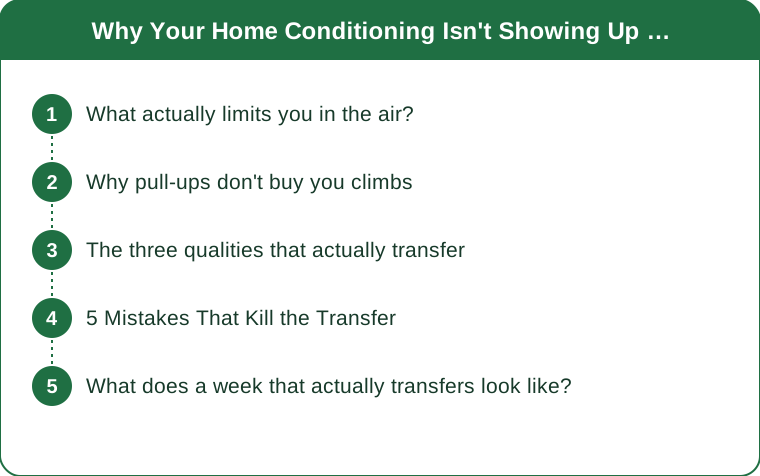
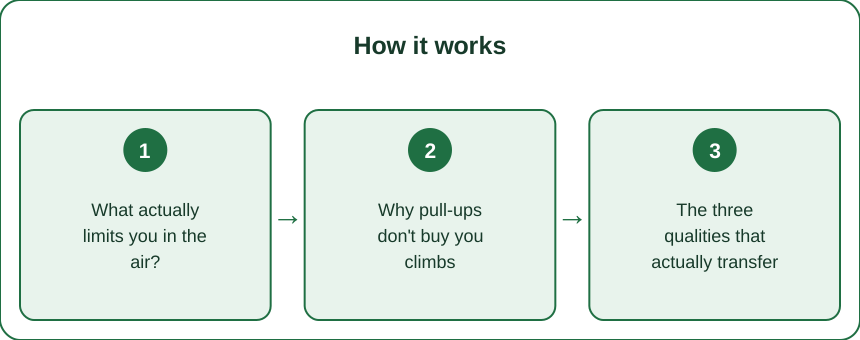
What actually limits you in the air?
Almost never the big muscles. When people fail on a climb they don’t fail because the lats gave out — they fail because the forearms cooked, the skin gave up, or the shoulder lost its position and everything downstream got harder.
Those three are the real ceiling for most students in the first two years, and floor conditioning trains almost none of them well.
Grip on a pull-up bar is a closed hand around a rigid, textured, predictable cylinder. Grip on silks is a hand wrapped around compressible fabric that changes shape under load and demands continuous micro-adjustment. The muscles overlap; the demand doesn’t.
And skin is a genuinely separate trainable tissue with its own adaptation timeline. No amount of strength work conditions your palms and the inside of your foot — only fabric time does that.
Why pull-ups don’t buy you climbs
A strict pull-up is a vertical pull with your body hanging in a stable line under a fixed bar. Nothing rotates, nothing compresses, and the handle stays exactly where you put it.
A climb is a series of one-armed-ish pulls under rotation, where the fabric twists, your body swings slightly out of line, and each pull happens from a slightly different shoulder angle. The stabilizers are doing as much work as the movers.
This is why people with a solid five pull-ups still struggle on climbs while someone with two pull-ups and a lot of hang time climbs cleanly. The limiting quality is position under instability, not peak pulling force.
It’s also why the fix isn’t more pull-ups. It’s pull-ups made unstable — on rings, on a towel over the bar, with a pause and a deliberate rotation — plus a lot more time simply hanging.

The three qualities that actually transfer
1. Grip endurance, not grip strength. You need to hold, not to crush. Train it with time: dead hangs to 80 percent of failure, three to four sets, three days a week. Add a towel or a folded strap over the bar to get closer to the fabric demand. Progress by adding seconds, not weight.
2. Shoulder engagement at end range. The single most transferable drill is the active hang — hanging fully extended, then pulling the shoulder blades down and back without bending the elbows. Ten seconds on, ten off, five rounds. This is the position that collapses on a climb, and it’s trainable in a doorway.
3. Skin and tissue tolerance. Only fabric builds this, which means more short sessions beat fewer long ones. Two 40-minute sessions a week condition skin better than one 90-minute session, because the tissue gets a stimulus twice with recovery in between.
Notice that none of these three feel like hard workouts. That’s part of why people skip them for pull-ups, which feel productive and buy less.
5 Mistakes That Kill the Transfer
1. Training grip to failure every session. Forearms recover slowly and aerial already loads them twice a week. Grip work taken to failure leaves you weaker in class, which is where the real practice happens.
2. Conditioning on the same day as class, before class. You arrive with pre-fatigued forearms and then wonder why the climb regressed. Put conditioning on off days or after class.
3. Chalking to fix a skin problem. Chalk fixes moisture. It doesn’t fix skin that hasn’t been conditioned, and heavy chalk on fabric can actually reduce the friction you’re relying on.
4. Ignoring the feet. Foot locks are a skin and ankle-position skill, and people condition the upper body exclusively then blame their arms for a failure that started at the foot.
5. Adding volume instead of frequency. The third mistake on this list is the one that surprises experienced students — more classes per week beats longer classes, for both skin and grip, and most people do the opposite when they want to progress faster.
What does a week that actually transfers look like?
Assuming two aerial classes a week, which is the common case:
- Class days: nothing extra beforehand. Afterward, optional five minutes of forearm and wrist mobility.
- Two off days: active hangs (5 × 10 seconds), dead hangs (3 sets, stopping short of failure), and one unstable pull variation — rings, towel, or slow negatives, 3 sets of 3 to 5.
- One day: lower body and core, which do transfer more directly and are the least likely to interfere with grip.
- At least one full rest day, more if your palms are still tender.
The honest timeline: grip endurance responds in four to six weeks, skin in six to eight, shoulder position fastest of all. If nothing has changed after two months of this, the issue is more likely technique — specifically how much you’re gripping when you don’t need to — and that’s a conversation with your instructor, not a programming problem.
This is general information, not medical advice. Persistent shoulder or wrist pain, or numbness in the hands, is a reason to see a professional rather than train through it.
TL;DR:
- You fail in the air on grip endurance, skin, and shoulder position — not on the big pulling muscles.
- Pull-ups train a stable, fixed-handle pull. Silks demand pulling under rotation on compressible fabric.
- Train dead hangs and active hangs for time, stopping short of failure, on off days only.
- Skin conditions with frequency, not duration — two short sessions beat one long one.
- Expect four to eight weeks before the transfer shows, and suspect technique if nothing moves after two months.
Stop chasing a bigger pull. Hang more, hang better, and give your hands a reason to toughen up.
See It in Motion
Seen here: High Waist Yoga Leggings with Inner Pocket — shop it on bubblelime.com
Keep Reading
This article is for general informational and styling purposes only. Fit, sizing, and product availability may vary.