Why Your Legs Shake in an Aerial Hold (and When Shaking Is a Stop Signal)
Quick Answer: Shaking during a held aerial position is usually normal - it reflects your nervous system cycling through motor units to sustain a contraction near your current limit, and it is especially common in unfamiliar positions where stabilizer muscles are doing unpracticed work. It is worth respecting rather than pushing through when it appears in a grip-critical position, when it starts unusually early, or when it comes with numbness, sharp pain, or a hand that is losing control. Treat shaking in the hands as a stop signal even when shaking in the legs is fine.
You are holding a straddle in the silks, everything is fine, and then your thigh starts doing something that looks alarming and feels worse. Your instructor says that is normal, keep going. Sometimes that is exactly right. Sometimes it is the moment to come down, and knowing which is which is a real safety skill.

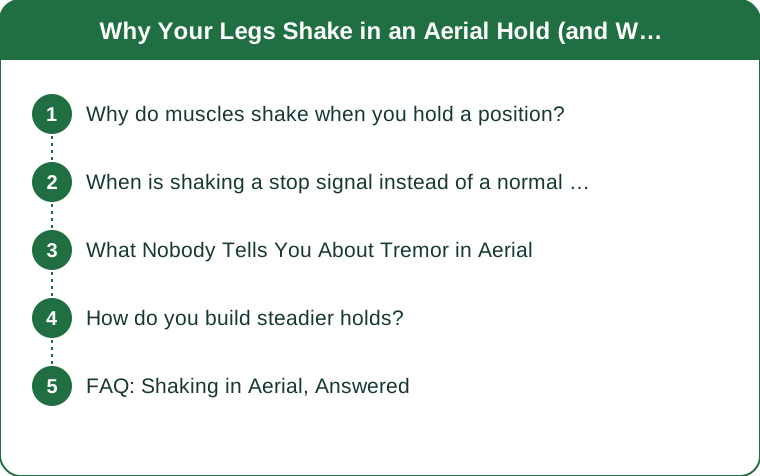
Why do muscles shake when you hold a position?
Because sustaining a contraction is a rotation, not a single effort. Muscles are made of motor units, and to hold a position for any length of time your nervous system cycles which ones are firing so that some can recover. When you are near the limit of what the available units can produce, the handoffs get less smooth and the result is visible oscillation - the tremor you are watching.
Unfamiliar positions shake more at any strength level. Coordination is specific. A person who squats heavily can shake dramatically in an aerial straddle because the stabilizing pattern is new, the joint angles are unusual, and the body is still learning which units to recruit and in what order. This is one reason shaking is so common in the first months of aerial and then fades even when nothing about your strength has dramatically changed.
Fatigue, temperature, and blood sugar all amplify it. A cold studio, a late class after a long day, or training on an empty stomach all increase the visible tremor without saying anything different about safety.
Inverted positions add another layer. Holding position while upside down changes blood pressure regulation and breathing mechanics, and many people unconsciously breath-hold in inversions - which raises intrathoracic pressure and can contribute to both trembling and light-headedness.
Being watched makes it worse. Mild adrenaline increases baseline muscle activation and tremor. This is why the shake often shows up in the moment you are being spotted or filmed and disappears when you repeat the same shape alone.
When is shaking a stop signal instead of a normal signal?
The distinction is about which tissue is shaking and what else is happening.
Shaking hands or forearms in a grip-dependent position: come down. This is the one non-negotiable. Grip failure in aerial is not gradual and forgiving - a forearm that has started to tremble is close to the point where you cannot choose when to let go. Descend while the decision is still yours.
Shaking accompanied by numbness or tingling: come down. Sustained pressure on nerves from a wrap, or a position that compresses a limb, produces a very different sensation from muscular fatigue. Numbness is a pressure signal, not an effort signal.
Sharp, localized, or joint-line pain: come down. Muscular tremor is diffuse and burning. Sharp pain at a specific point, especially at a shoulder, elbow, or wrist, is not a training signal.
Shaking that appears far earlier than usual: stop and investigate. If a shape you normally hold comfortably produces heavy tremor at five seconds, something changed - illness, sleep debt, under-fueling, or accumulated fatigue from prior sessions. That is information about your recovery, not a challenge to overcome.
Light-headedness, visual changes, or nausea in an inversion: come down immediately and rest before trying again. Especially if you have been holding your breath.
Everything else - diffuse trembling in the working muscles of a hard position, with steady breathing and reliable grip - is generally the normal version. Which does not mean it should be maximized. Consistently training to visible tremor is a recipe for a fatigue-driven technique error later in the class.

What Nobody Tells You About Tremor in Aerial
Nobody tells you tremor migrates as your technique improves. Beginners often shake in the arms because they are muscling shapes that are meant to be structured by wraps and skeletal position. As technique improves, the shake moves to the legs and core - which reads as getting worse and is actually a sign the load moved to the right places.
Nobody tells you that breathing changes it immediately. A held breath both increases tremor and shortens the time you can stay up. Deliberately exhaling during a hold often visibly reduces the shake within a couple of seconds, which is the fastest self-test available for whether you are dealing with fatigue or with breath holding.
Nobody tells you that shaking is worse near the top of a progression, not at the hardest skill. The most tremor-inducing moment is usually the shape just beyond comfortable - the one you can hold but only barely. Genuinely too-hard shapes fail fast and cleanly; genuinely easy ones do not shake. Persistent tremor means you are training in exactly the productive zone, which is useful to know.
Nobody tells you that cycle phase and hydration measurably affect it. Many aerialists report noticeably more tremor and less endurance in the days before a period, and dehydration reliably worsens both. Neither is a reason to skip class; both are reasons to adjust expectations on a given day.
And nobody tells you that watching your own shaking makes it worse. Attention on a trembling muscle increases activation. Looking at a fixed point and breathing out is not just calming - it measurably helps.
How do you build steadier holds?
Train the shape below the one that shakes, more often. Endurance in a position comes from accumulated time in it, and time is easier to accumulate at 70 percent of your limit than at 100 percent. Three sets of a comfortable 15-second hold builds a steadier 25-second hold faster than one desperate 25-second attempt.
Add isometric work on the ground. Hollow body holds, straddle sits, and active hangs build the same sustained-contraction capacity without the grip cost, which means you can train them on days when your hands need a break. Hands and forearms are the tissue most likely to be the limiting factor in aerial, and they recover more slowly than most people expect.
Respect grip recovery specifically. Two heavy silks days back to back is one of the most common causes of both shaking and stalled progress. Grip-intensive training tends to need more recovery time than leg-dominant work, so alternating heavy grip days with conditioning days is the standard structure for a reason.
Fuel and hydrate for evening classes. A class at 7 pm on a coffee-and-nothing day will shake. This is unglamorous and it is frequently the entire explanation.
Exhale in the hold and pick a fixed gaze point. Both reduce tremor immediately and cost nothing.
And log the early-shake days. If tremor arrives much earlier than normal for more than a couple of sessions, that pattern is worth attention - it can reflect accumulated fatigue, under-recovery, or something that deserves a professional opinion. This is general information, not medical advice; persistent unexplained tremor, weakness, or numbness should be discussed with a clinician.
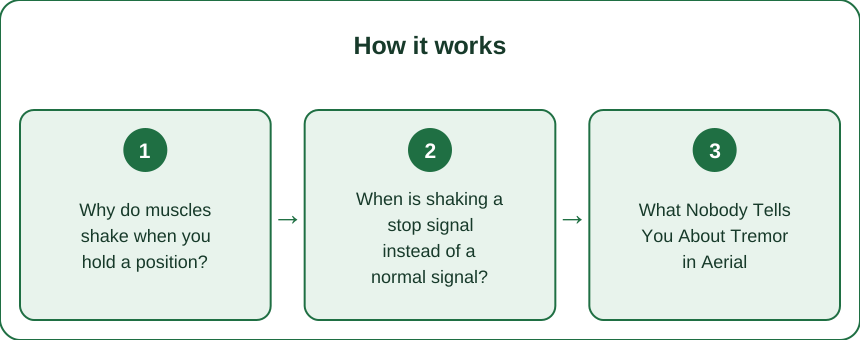
FAQ: Shaking in Aerial, Answered
Is it normal for my legs to shake in aerial silks?
Usually yes. Visible tremor in the working muscles of a demanding position reflects normal motor unit cycling near your current limit and is very common in unfamiliar shapes. Diffuse burning tremor with steady breathing and a reliable grip is the normal version.
When should I come down instead of holding?
Come down immediately if your hands or forearms are shaking in a grip-dependent position, if you have numbness or tingling, if pain is sharp or at a joint, or if you feel light-headed or nauseated in an inversion. Grip tremor in particular is a stop signal, not a challenge.
Why do I shake more in some classes than others?
Sleep, fuel, hydration, studio temperature, accumulated fatigue from previous sessions, cycle phase, and being watched all affect tremor without changing your underlying strength. Tremor that shows up much earlier than usual is a recovery signal worth noticing.
How do I stop shaking in holds?
Accumulate time in easier versions of the shape rather than repeatedly attempting the hardest one, add ground-based isometric holds, protect grip recovery between heavy days, and exhale with a fixed gaze during the hold. Breath holding is a frequent and very fixable contributor.
TL;DR:
- Shaking in a hold is usually normal motor unit cycling near your limit, and it is especially common in unfamiliar shapes regardless of overall strength.
- Treat trembling hands or forearms in a grip-dependent position as a hard stop - grip failure is sudden rather than gradual.
- Numbness, sharp or joint-line pain, and light-headedness in an inversion are all stop signals rather than effort signals.
- Tremor that arrives much earlier than usual is information about recovery, fuel, and sleep, not a call to push harder.
- Build steadier holds with more time in easier versions, ground isometrics, protected grip recovery, and deliberate exhaling.
The shake is usually your body doing exactly what it should while it learns a shape. The skill worth building is not ignoring it - it is knowing the difference between the version that means keep training and the version that means come down now. This is general information, not medical advice.
See It in Motion
Seen here: Racerback Tank Top - White — shop similar styles on bubblelime.com
Keep Reading
This article is for general informational and styling purposes only. Fit, sizing, and product availability may vary.