The Core Workout Hiding in the Hammock
Quick Answer: Aerial yoga trains your core through constant instability. Because the hammock moves, your deep abdominals make hundreds of small corrections per class to keep you level — the same anti-movement work a plank does, spread across 50 minutes without you noticing. That’s why your abs hurt the next day.
The morning after your first aerial class, your abs file a formal complaint.
Which is genuinely confusing, because what you remember is floating, laughing, and being upside down for a while. At no point did anyone say “hold this for 45 seconds.”
That’s the trick. The hammock is a core-training device wearing a silk disguise.

Why does aerial yoga work your core so much?
Because the fabric moves, and you don’t want to.
On a mat, the floor is a fixed reference. Your core works, but it works against something predictable. In a hammock, the anchor point sways with every breath and every shift of weight. Your deep core — transverse abdominis, obliques, the small spinal stabilizers — has to respond to each of those movements to keep your torso level.
Those corrections happen continuously, hundreds of times across a 50-minute class, and each one is a small isometric contraction. Add them up and you’ve done a considerable amount of stabilization work, distributed so thinly across the hour that it never registers as effort.
This is the same training principle behind stability balls, suspension trainers, and balance boards: instability raises the demand on stabilizer muscles without adding any load. The hammock just does it in three dimensions instead of one.
It is, functionally, a plank you forgot you were doing.
What makes a suspended plank harder than a floor plank?
Two things stack on top of each other.
Put your feet in the hammock and your hands on the floor and you’ve built a plank with an elevated, moving anchor. The elevation shifts more of your bodyweight forward onto your arms and shoulders. The movement means your core can’t settle into a fixed brace — it has to keep re-finding the line.
A standard plank asks you to hold a position. A suspended plank asks you to hold a position while something actively tries to move you out of it. The second is meaningfully harder, and it recruits more of the small stabilizers around the pelvis and ribcage.
The useful part: because the instability supplies the difficulty, you don’t need to hold it for two minutes. 20–30 seconds of a genuinely controlled suspended plank does more than 90 seconds of a sagging floor plank.
If you’re new to it, start with the knees lower and the hammock closer to hip height. Range and elevation are both dials you can turn down.
Do inversions really use the core?
Almost entirely, yes.
Getting upside down gracefully is a controlled curl — you’re rolling your pelvis over your hands or hips with your abdominals doing the steering. Getting upside down ungracefully is a flop, where gravity does it and you arrive. Both end up inverted; only one is training.
The core is working at three separate moments: the entry (a controlled hip-over-shoulder curl), the hold (bracing so your ribs don’t flare and your lower back doesn’t dump into extension), and the exit (an eccentric lower, which is where most of the soreness comes from).
Eccentric work — muscles lengthening under load — reliably produces more delayed-onset soreness than concentric work. So if your abs are specifically sore, it’s likely the coming-down that did it, not the going-up.
The elegance is abs. It was always abs.
Why doesn’t it feel like a workout at the time?
Because play hides effort, and your brain files the two things separately.
Perceived exertion isn’t a direct readout of physical work. It’s heavily modulated by novelty, enjoyment, and whether you’ve mentally labeled the activity as “exercise.” A class you’ve categorized as fun simply doesn’t trigger the same internal complaint department as a set of sit-ups — even at identical effort.
The other factor is distribution. Aerial core work is spread across 50 minutes in small doses, and there’s never a single moment intense enough to register as “this is the hard part.” Traditional core training concentrates the same volume into four minutes of obvious suffering.
The soreness is just the receipt arriving a day late.
What Nobody Tells You
Your grip and forearms will go before your core does. Nobody warns you about this. The first few classes, the limiting factor is usually how long you can hold the fabric, not how strong your abs are. It sorts itself out in three or four sessions.
The fabric bruises. Small pressure marks on the hips, backs of the knees, and inner arms are completely normal for the first month. They fade as you learn to distribute pressure.
Wear the right clothes or you’ll learn the hard way. You need fabric between the hammock and your skin at the armpits and backs of the knees — silk on bare skin at those points is genuinely unpleasant. A fitted top with some sleeve coverage and high waist leggings that stay put when inverted solve both problems. Loose clothing is the real mistake here: anything that can slide will slide when you’re upside down.
Don’t eat beforehand. Give it two hours. Inversions and a full stomach are a poor combination, and this is the single most common rookie error.
FAQ
Is aerial yoga good for building core strength?
Yes, particularly for the deep stabilizing muscles that are hard to target directly. It won’t build visible abdominal size the way loaded training does, but for spinal stability, postural control, and the anti-rotation strength that carries into everyday movement, it’s genuinely effective. Two classes a week produces noticeable change in about six weeks for most beginners.
How long before I feel stronger?
Most people notice better control and less shakiness by week three, and meaningful strength change around weeks six to eight at two sessions a week. Grip and shoulder endurance usually improve first, core control second.
Do I need core strength before starting aerial yoga?
No. Beginner classes are built to scale, and the hammock supports a large portion of your bodyweight in most poses. If you can hold a 20-second plank on your knees, you have enough to start a beginner class.
Is it safe for my back and neck?
For most healthy people, yes — and spinal decompression is one of the commonly reported benefits of hanging inversions. But it isn’t for everyone. Talk to a physician before starting if you have high blood pressure, glaucoma or other eye conditions, a history of vertigo, recent surgery, disc problems, or are pregnant. Always go to a supervised class with a qualified instructor rather than rigging a hammock at home, and tell them about any condition before you start.
TL;DR:
- The hammock moves, so your deep core makes hundreds of corrections per class
- Suspended planks beat floor planks — instability plus elevation; 20–30 seconds is plenty
- Inversions are a controlled curl; the eccentric lower causes most of the soreness
- Play masks effort, and the work is spread thin — that’s why it doesn’t feel hard
- Grip fails before your core does; expect fabric bruises for a month
- Wear fitted clothing with sleeve coverage, and don’t eat for 2 hours beforehand
- Check with a physician first if you have blood pressure, eye, or spinal conditions
You didn’t just hang around. You did a hundred secret planks in a silk cocoon.
See It in Motion
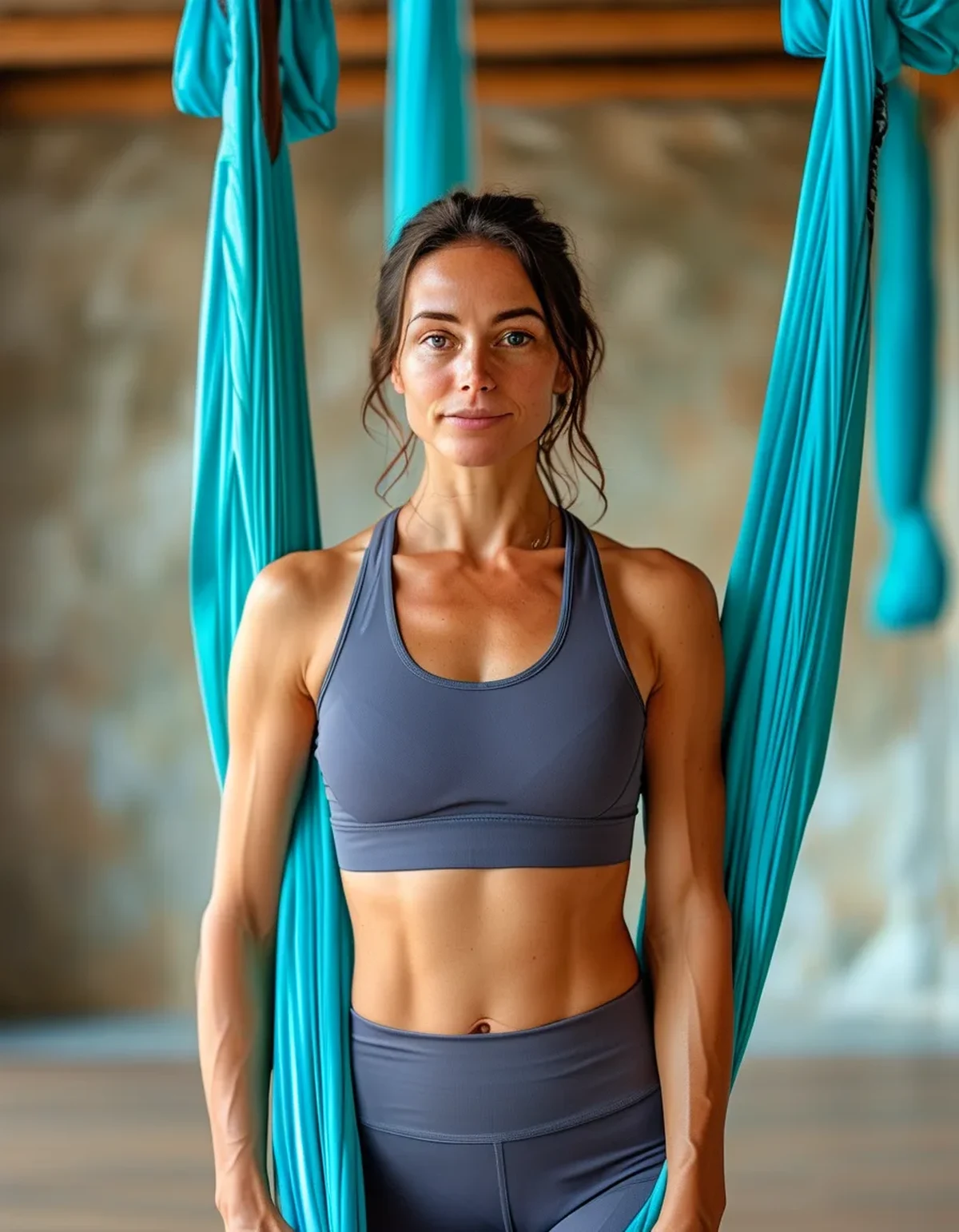
Seen here: UPF 50+ Racerback Yoga Tank Top — shop it on bubblelime.com
Keep Reading
This article is for general informational and styling purposes only. Fit, sizing, and product availability may vary.