Is Shoulder Clicking During Aerial Normal, or a Warning Sign?
Quick Answer: Painless shoulder clicking during aerial is usually harmless and related to tendons or the joint capsule moving over bone during a wide range of motion — common in aerialists due to the sport’s demands. Clicking accompanied by pain, weakness, or a feeling of instability is a different story and warrants evaluation.
Almost every aerialist has heard their shoulder click during an inversion or a climb and wondered if something’s wrong. Most of the time it isn’t — but the context around the click matters more than the sound itself.

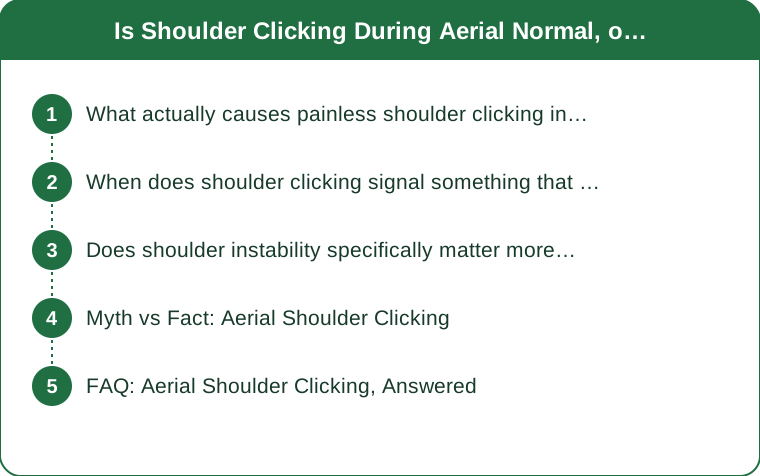
What actually causes painless shoulder clicking in aerial?
Aerial work takes the shoulder through an unusually large range of motion under load, and clicking without pain is often just a tendon or the joint capsule shifting position as the arm moves through extreme angles — a mechanical sound, not a sign of damage. This is common enough among aerialists that it’s rarely, by itself, cause for concern.
The key distinguishing factor is consistency: harmless clicking tends to happen at the same point in the same movement every time, without any accompanying pain or change in strength.
When does shoulder clicking signal something that needs attention?
Clicking paired with pain, a sense of the shoulder ‘giving way,’ or noticeable weakness in specific positions (especially overhead or in a deep inversion) is a different pattern that shouldn’t be trained through. This combination can indicate anything from tendon irritation to early instability, and pushing through it tends to make aerial-specific injuries worse rather than something that resolves on its own.
A new click that appears suddenly, especially after a fall or a hard catch, is also worth treating differently than a click you’ve had consistently for months.

Does shoulder instability specifically matter more for aerialists than other athletes?
Yes — aerial disciplines ask the shoulder to bear body weight in positions (deep external rotation, full overhead load) that most other sports never require, which means even mild instability that would be a non-issue for a runner or lifter can become a significant risk factor for an aerialist. This is part of why aerial-specific shoulder conditioning (not generic gym shoulder work) matters so much for injury prevention.
Building rotator cuff and scapular stability work into a regular training routine — not just flexibility and hangs — is one of the most effective ways to reduce this risk over time.
Myth vs Fact: Aerial Shoulder Clicking
Myth: Any clicking sound means something is wearing down in the joint. Fact: Most clicking is mechanical tendon or capsule movement, not joint degradation — pain and instability are the actual warning signs, not sound alone.
Myth: If it doesn’t hurt right now, it’s fine to keep training through it. Fact: Some shoulder issues, especially instability, build gradually and don’t always hurt until they’ve progressed — a change in your shoulder’s behavior is worth noting even without immediate pain.
FAQ: Aerial Shoulder Clicking, Answered
Should I stop training if my shoulder clicks but doesn’t hurt?
Generally no, but track it — if the click stays consistent and painless over weeks, it’s likely benign; if it changes or pain appears, that’s the time to pull back and get it evaluated.
Does shoulder clicking mean I need to strengthen or stretch more?
Most aerial shoulder issues respond better to targeted strengthening (especially rotator cuff and scapular stabilizers) than to additional stretching, since aerialists are rarely lacking flexibility in that joint.
When should I actually see a physical therapist about it?
If clicking is new, paired with pain or a feeling of instability, or follows a fall or hard catch, a sports-focused physical therapist familiar with aerial or gymnastics movement patterns is worth seeing before continuing full training.
TL;DR:
- Painless, consistent clicking is usually mechanical and not a cause for concern
- Clicking with pain, weakness, or a feeling of instability is a different, more serious pattern
- Aerial’s extreme overhead loading makes shoulder stability work especially important
- A sudden new click, especially after a fall, deserves evaluation rather than training through
This is general information, not medical advice — a sports-focused physical therapist is the right call for anything beyond simple, consistent, painless clicking.
See It in Motion
Seen here: Bootcut Capri Yoga Pants with Pockets — shop similar styles on bubblelime.com
Keep Reading
This article is for general informational and styling purposes only. Fit, sizing, and product availability may vary.