Why Adding More Aerial Classes Can Slow Your Progress Down
Quick Answer: Aerial loads connective tissue - tendons, ligaments, and joint capsules in the shoulders, elbows, and wrists - which adapts far more slowly than muscle. Adding classes tends to outpace connective tissue recovery, producing grip failure, elbow pain, and stalled skills. For most intermediate students, 2-3 aerial sessions per week with dedicated rest days outperforms 4-5.
You plateaued, so you added classes. Six weeks later your grip is worse, your elbows ache, and the skill you were close to has gone backwards. This is one of the most common patterns in aerial, and the mechanism is specific.

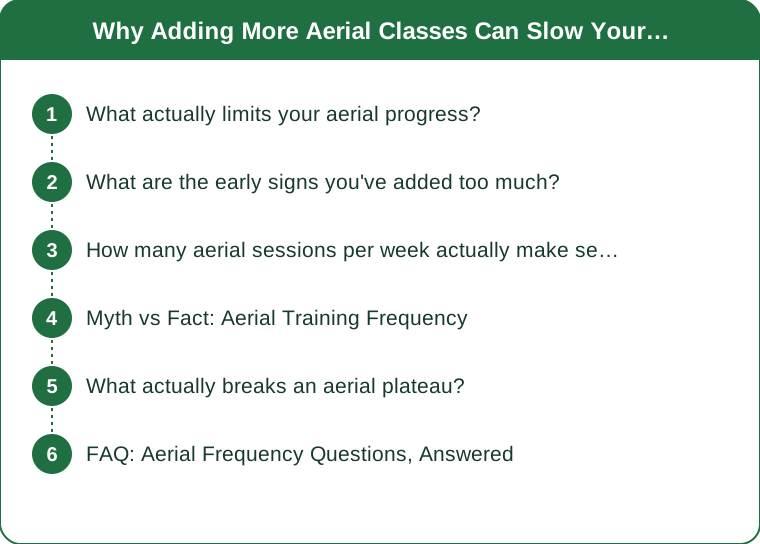
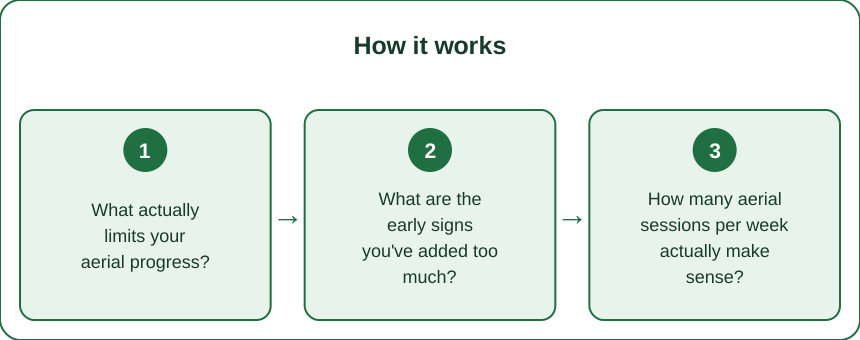
What actually limits your aerial progress?
Aerial is unusual among fitness disciplines in how much load it puts through connective tissue rather than muscle. Every hang, wrap, and inversion transmits force through tendons at the elbow and shoulder, the wrist retinaculum, and the shoulder joint capsule.
Muscle adapts relatively quickly - meaningful changes within 48-72 hours of recovery. Tendon and ligament adapt far more slowly, partly because they have significantly lower blood supply. Adaptation timelines here are commonly discussed in terms of weeks to months rather than days.
This creates a specific mismatch: your muscles feel ready for another class two days later while the connective tissue carrying the actual load is still behind. Training on that schedule repeatedly means you’re always adding load to tissue that never fully caught up.
The result isn’t dramatic injury on any given day. It’s a slow accumulation that shows up as grip that fails earlier than it used to, a nagging elbow, and skills that stop progressing for no obvious reason.
What are the early signs you’ve added too much?
These show up in a fairly reliable order, and catching them early saves months.
Grip fails earlier than it did a month ago. This is usually the first signal and it’s frequently misread as needing more grip training - which adds load to the exact tissue that’s already behind.
Elbow or forearm ache the day after class, particularly on the inside of the elbow. Aching that lasts beyond 48 hours is a load signal, not normal soreness.
Skills you had reliably become inconsistent. Losing a skill you’d owned for weeks is more often fatigue than technique regression.
Bruising takes longer to fade. Slower tissue turnover across the board tends to show up in how bruises behave.
Warm-up takes noticeably longer to feel ready. If you used to feel warm in ten minutes and now need twenty-five, that’s accumulated load talking.
Any two of these together is worth a deload week. Three is worth a conversation with a physio.
How many aerial sessions per week actually make sense?
There’s no universal number, but some workable ranges for most recreational adult students:
- Beginner (0-6 months): 1-2 aerial sessions per week. Connective tissue is starting from an untrained baseline and this is the phase where over-eagerness does the most damage.
- Intermediate: 2-3 sessions, with at least one full rest day between them. This is where most people over-add.
- Advanced or performance-focused: 3-4, usually with deliberate variation in intensity - not four maximal sessions.
The more useful variable than frequency is consecutive-day exposure. Two aerial sessions back to back is meaningfully harder on connective tissue than the same two sessions spaced across the week. If your schedule forces consecutive days, make one of them substantially lighter.
Also worth counting: conditioning that loads the same tissue. Pull-ups, hangs, and heavy pulling work aren’t rest from aerial. They’re aerial load in a different room.

Myth vs Fact: Aerial Training Frequency
Myth: If you’re not sore, you’re recovered. Fact: Muscle soreness tracks muscle recovery, not connective tissue recovery. You can feel completely fresh while tendons are still adapting from three days ago.
Myth: Grip failure means you need more grip training. Fact: When grip has gotten worse rather than plateaued, that’s usually a recovery signal. Adding grip work to a fatigued forearm is how people acquire an elbow problem.
Myth: More time in the air always means faster skill acquisition. Fact: Skill acquisition needs quality repetitions. Fatigued repetitions build fatigued movement patterns, which then need unlearning.
Myth: Rest days mean doing nothing. Fact: Light mobility, walking, and lower-body work are all compatible with connective-tissue recovery in the upper body. Rest is specific, not total.
What actually breaks an aerial plateau?
A deload week. One week at roughly half your usual volume is the intervention most likely to unstick a plateau, and it’s the one people resist most. The number of students who return from a holiday and immediately land a skill they’d been chasing for months is not a coincidence.
Targeted conditioning on non-aerial days, at low load. Shoulder external rotation work, scapular control, and wrist and forearm mobility support the tissue that’s limiting you without adding hang time.
Video review instead of another class. Many plateaus are technique problems that more repetitions reinforce rather than solve. Twenty minutes reviewing footage with a coach frequently beats another two hours in the air.
Sleep and protein. Both matter more for connective tissue adaptation than most aerialists account for, and both are commonly compromised in exactly the period when someone has added classes to a full schedule.
Patience with the timeline. Connective tissue adapts on a scale of weeks to months. A plateau of three weeks is not a plateau - it’s the normal texture of a slow-adapting discipline. This is general information, not medical advice; persistent joint pain deserves a physio’s assessment.
FAQ: Aerial Frequency Questions, Answered
Can I do aerial and lifting in the same week?
Yes, but count upper-body pulling work as part of your total aerial load. Lower-body lifting is far more compatible with aerial recovery than heavy pulling is.
How long should a deload week actually be?
One week at about half volume is the standard starting point. If symptoms haven’t improved after two weeks, that’s a signal to get it assessed rather than to keep deloading indefinitely.
Is it normal for progress to be slower after the first six months?
Yes. Early gains come largely from neural learning and are fast. Later gains depend more on tissue adaptation, which is genuinely slower. The slowdown is expected, not a sign anything’s wrong.
Should I train through mild elbow ache?
Mild ache that resolves within 24 hours is usually manageable with reduced volume. Ache that persists past 48 hours or worsens during class is worth stopping for and getting looked at.
TL;DR:
- Aerial loads connective tissue, which adapts on a timeline of weeks, not days
- Grip failing earlier than before is usually the first over-load signal, not a grip-training need
- 2-3 sessions per week with rest days between suits most intermediate students
- Count pulling conditioning as aerial load, because your tendons do
- A deload week unsticks more plateaus than an extra class does
More air time isn’t the lever. Recovered tissue is. This is general information, not medical advice.
See It in Motion
Seen here: Bootcut Capri Yoga Pants with Pockets — shop similar styles on bubblelime.com
Keep Reading
This article is for general informational and styling purposes only. Fit, sizing, and product availability may vary.