Why Your Aerial Grip Stalls at the Same Point Every Time
Quick Answer: Grip plateaus in aerial are usually caused by shoulder disengagement, not weak fingers. When the shoulders stop supporting the hang, the forearms take load they were never meant to hold, and they fail at a fixed point regardless of how much extra grip work you do. Fix active shoulder engagement first, then train grip in the specific position that is failing.
You have added farmer’s carries, you have bought the grip trainer, and the hang still ends at the same place it did in June. That consistency is the clue - a genuine strength limit moves, even slowly. A structural one sits still.

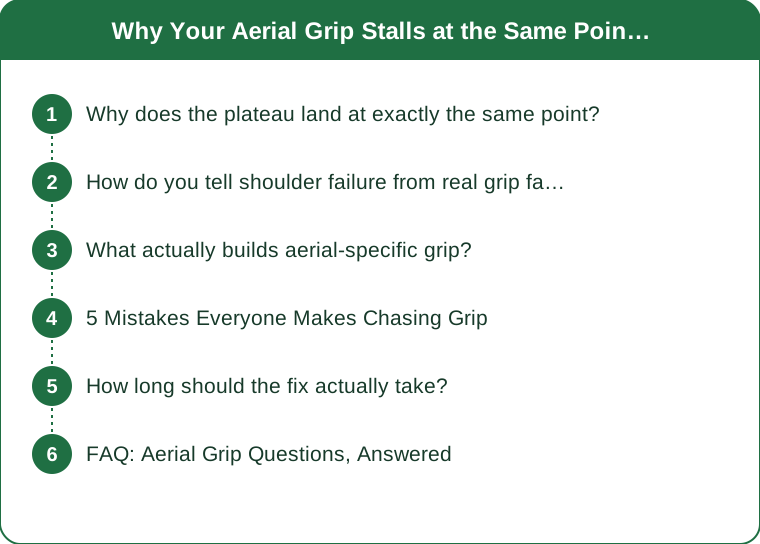
Why does the plateau land at exactly the same point?
Because you are not running out of grip. You are running out of the thing that was protecting your grip.
In a properly supported hang, load is shared: the lats and the muscles around the shoulder blade hold the body in relation to the arms, and the hands hold the apparatus. When the shoulder support fades - usually between 15 and 25 seconds for an intermediate athlete - the shoulders travel toward the ears, the body hangs passively, and the entire load transfers down the chain to the forearms.
From that moment the clock is running on a much smaller muscle group. The forearms then fail in a fairly predictable few seconds, which is why the total is so repeatable.
The tell: if your hang always ends at a similar time and the last few seconds feel like a fast burn in the forearms rather than a gradual fade, the failure point upstream is the shoulder, not the hand.
This is also why isolated grip training so often produces no improvement. You are strengthening the part that is failing second.
How do you tell shoulder failure from real grip failure?
Run this two-part test on a day when you are fresh.
Test 1 - the assisted hang. Hang with your feet lightly resting on a box or the floor, taking maybe 20 percent of your weight. If your time roughly doubles or more, the limit was systemic support, not the hands. If it improves only slightly, the hands are genuinely the limit.
Test 2 - the shoulder position check. Film a hang from the side. Watch the moment the ears disappear between the shoulders. Note that timestamp, and note when you dropped. If the shoulder position collapsed 5 or more seconds before you let go, the shoulders gave up first and the forearms just absorbed the consequences.
Most intermediate aerialists find the collapse happens surprisingly early - often before the halfway point of what they thought was a grip-limited hang.
A third signal: does your grip fail faster on the apparatus than on a straight bar? If so, it is not raw grip - it is the shoulder stability demand of an unstable apparatus, which is much higher.
What actually builds aerial-specific grip?
Specificity matters more here than in almost any other strength quality, because grip is highly position-dependent.
Train the shoulder support first:
- Active hangs, shoulders pulled down and back, 3 sets of 15 to 20 seconds, focusing on holding the position rather than the time. Stop the set when the position goes, not when the hands do.
- Scapular pull-ups, 3 sets of 8, slow. This is the direct drill for the exact quality that is failing.
- Hollow-body holds, 3 sets of 20 seconds, because a hanging body without core tension swings and doubles the grip cost.
Then train grip in the failing position:
- If you fail in a fabric grip, train on fabric. Bar work transfers poorly to a compressible, rotating surface.
- Mixed-grip and single-arm loaded holds, 3 sets of 10 to 15 seconds per arm, only after shoulder work is established.
- Two sessions per week maximum for dedicated grip work. Forearms recover slowly and the most common cause of a stubborn plateau is training grip while never actually recovering it.
Progression rule: add time before adding load. Aerial grip is an endurance quality far more than a maximal one.

5 Mistakes Everyone Makes Chasing Grip
1. Training grip on a bar for an apparatus problem. A bar is rigid and predictable. Fabric compresses and rotates, hoop is a different diameter and metal, rope has texture. The forearm demand differs enough that transfer is partial at best.
2. Doing grip work at the end of every session. Fried forearms every session means never training them fresh and never fully recovering. Two dedicated slots a week, done properly, outperform six exhausted ones.
3. Over-chalking. Past a light coating, more chalk adds slip rather than friction, especially on fabric. If your hands are visibly white, you are probably past the useful point.
4. Ignoring skin as a limiter. Sometimes the plateau is not muscle at all - it is that your hands hurt. Skin conditioning progresses on its own timeline, and pushing through tears sets you back a fortnight. Manage calluses, file them flat, and stop before a hot spot becomes a tear.
5. Never training the specific failing shape. If you fail in one particular wrap, general hangs will not fix it. Train the shape, in short repeated holds, with full rest.
The third one catches almost everyone - people reach for more chalk exactly when the real problem is that the shoulders let go.
How long should the fix actually take?
Set expectations properly or you will abandon the change two weeks before it works.
Weeks 1 to 2: shoulder engagement work only, plus your normal classes. Hang times often do not move at all here, and sometimes dip slightly because you are now stopping sets on position rather than pushing to failure. This is not regression.
Weeks 3 to 5: the collapse point starts moving later. Film every second week and compare the timestamp of shoulder collapse rather than total hang time - that number moves first and is the honest measure of progress.
Weeks 6 to 10: total hang time improves, typically by a meaningful margin, because the forearms are now inheriting the load later and fresher.
Beyond 10 weeks: if nothing has changed and the assisted-hang test still doubles your time, the limiter is likely elsewhere - core tension, body weight distribution in the specific wrap, or technique. That is a coach conversation, not a training-volume one.
Persistent pain is a different category entirely. Elbow, wrist, or shoulder pain that lasts beyond a session, or numbness and tingling in the hands, means stop and see a physiotherapist. This is general information, not medical advice.
FAQ: Aerial Grip Questions, Answered
How often should I train grip specifically?
Two dedicated sessions a week is plenty alongside regular aerial classes. Forearms already get substantial work in class, and the plateau is more often under-recovery than under-training.
Do grip trainers and hand grippers help?
They build crushing strength, which is only part of what aerial needs. Aerial grip is largely a support and endurance quality on an awkward surface. Time under tension on the actual apparatus transfers far better.
Why is my grip much worse some days?
Sleep, hydration, and how much you trained two days ago all show up in the forearms quickly. Grip is one of the most sensitive indicators of overall fatigue, so a bad grip day is often a recovery signal rather than a skill one.
Should chalk or grip aids be used every session?
A light chalk layer is fine. Liquid grip has its place in humid rooms. Neither substitutes for skin conditioning, and heavy reliance can mask a technique issue that would otherwise show itself.
TL;DR:
- A plateau at the same time every session points to shoulder collapse, not hand weakness
- Test it: assisted hang doubling your time, or filmed shoulder collapse 5+ seconds before you drop
- Train scapular control and active hangs first, then grip in the exact failing position
- Two grip sessions a week maximum - under-recovery is a common hidden cause
- Track the shoulder collapse timestamp; it improves weeks before total hang time does
The reason extra grip work has not moved your hang is that grip was never the binding constraint. Move the failure point upstream, give it eight to ten weeks, and the number that has been stuck since June finally starts moving.
See It in Motion
Seen here: High Waist Bootcut Yoga Pants with Pockets — shop it on bubblelime.com
Keep Reading
This article is for general informational and styling purposes only. Fit, sizing, and product availability may vary.